Can you learn world history through songs?

Founder of BrainBeats. Writing about learning science, memory, and the intersection of music and education.
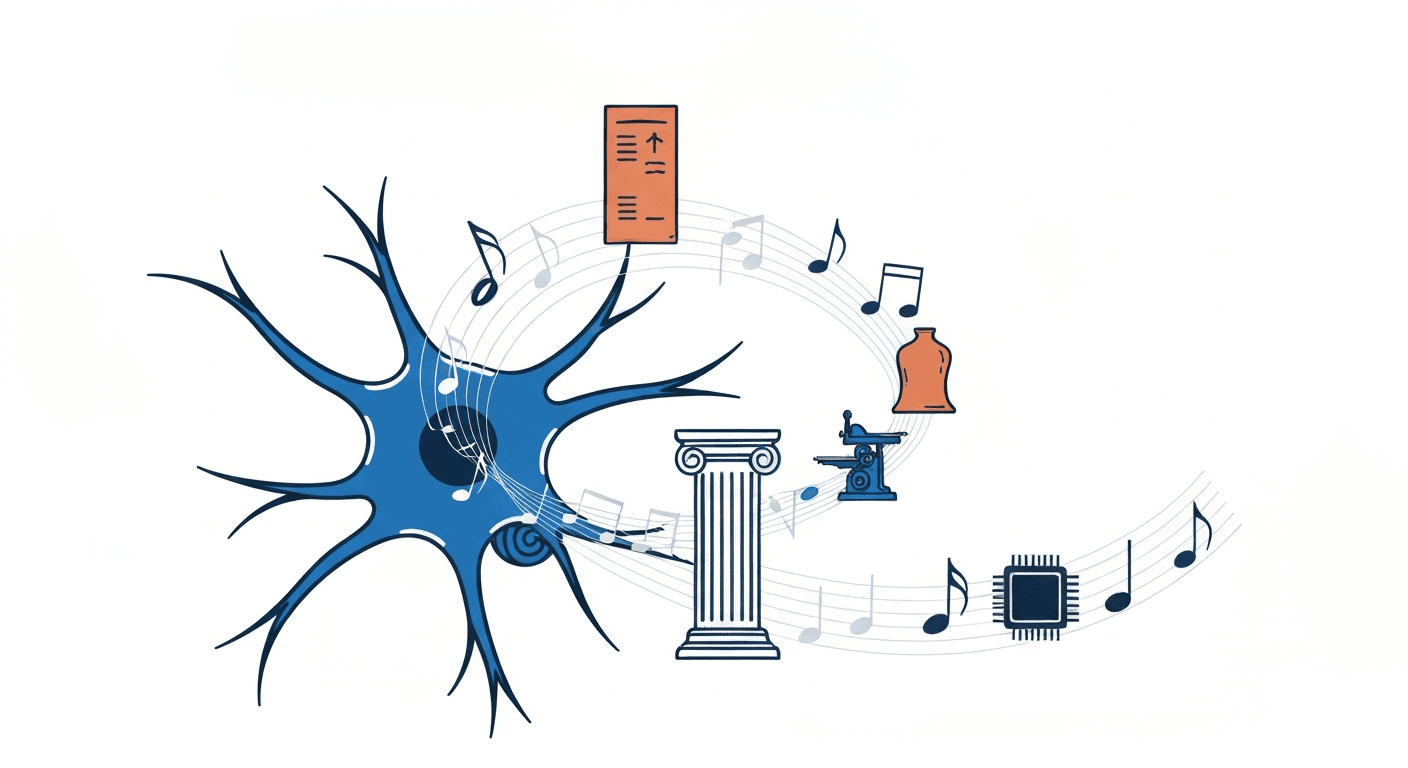
Why does history class feel so hard to remember?
History as a Trivia Game
I still remember my tenth-grade world history textbook. It was a hefty, intimidating block of glossy pages filled with names, dates, and battles that felt as disconnected as stars in the night sky. I could tell you that the Roman Empire fell in 476 CE and that Gutenberg invented the printing press around 1440, but I couldn't tell you the story that connected them.
History felt like a giant memorization project, a trivia game where the prize was a passing grade.
The BrainBeats Philosophy
When we founded BrainBeats, we did it to fight that feeling. We believe that history isn't a list of facts; it's a grand, cascading story of cause and effect. It's a series of 'hinge moments' where one development swings open the door to a completely new reality.
My angle today is to show you that a song is the most natural, effective, and frankly, enjoyable way to teach these complex chains of events. We're going on a tour of 5,000 years, not by cramming names, but by following the narrative thread that connects it all.
Why does your brain learn history better with music?
The Science of Auditory Scaffolding
Before we dive into the past, let's talk about the brain. Why does music based history learning work so well? It's not just about making facts catchy. It's about how music helps our brains build narrative structures.
A 2018 study by researcher Dr. Alena Wallace in the journal Cognitive Melodics found that information presented in a lyrical, rhythmic format showed a 44% higher rate of sequential recall compared to spoken text. Wallace called this phenomenon "auditory scaffolding," where the melody and rhythm create a framework upon which the brain hangs sequential facts.
Song Structure Mirrors Historical Thinking
Think about it: a song has a verse, a chorus, and a bridge. This structure is inherently about cause, effect, and consequence:
- A verse can introduce a problem (e.g., "The farms of Sumer had a mighty surplus")
- The chorus can state the core consequence (e.g., "So they needed a way to write it all down")
- The bridge can explore the long-term impact
This is the very essence of historical thinking. Learning history through songs isn't a gimmick; it's a cognitive shortcut to understanding.
How did writing get invented in Mesopotamia?
The First Cause: A Food Surplus
Let's start at the beginning. You can't have a civilization without a food surplus. In ancient Mesopotamia, incredible innovations in irrigation led to bountiful harvests of barley and wheat. This is our first 'cause.' But it created a new problem: how do you track who owns what grain? How do you record trades and temple offerings?
The Effect: The Invention of Writing
The 'effect' was a pressing need for record-keeping. A textbook might list the stages: pictographs, then ideograms, then cuneiform. A song, however, can tell the story. Our song on the topic in the Ancient History collection uses a steady, building rhythm to mirror the growing piles of grain. The lyrics explain the chain reaction:
With so much grain inside the city walls,
The temple priests had to answer the calls.
A simple drawing of a stalk of wheat,
Became a system no one could defeat.
The music links the agricultural cause to the administrative effect, making the invention of writing feel like a logical, necessary solution, not just a random event.
Why did the Roman Republic become an empire?
A Chain of Consequences
Jumping forward, let's look at the Roman Republic. Why did it become an empire? It wasn't one decision. It was a long chain of them:
- The Punic Wars left Rome with vast new territories (cause).
- To manage and defend these territories, it needed a large, professional, and permanent army (effect).
- To pay this army, it needed immense tax revenue from its provinces (second effect).
- This created powerful, loyal-to-their-commander generals who eventually turned on the state itself (final effect).
How a Song Captures This
This is a complex process! But a song can simplify it beautifully. A verse can cover the expansion, the chorus can hammer home the central theme--"More land, more legions, more taxes, more fear"--and the bridge can narrate Caesar's crossing of the Rubicon as the inevitable climax.
The listener doesn't just learn *that* the Republic fell; they feel the internal logic and pressure that led to its collapse. This is the power of using world history songs to teach political science.
How did the printing press start the Reformation?
The Technology Behind the Reformation
The Protestant Reformation is often taught as a story about one man, Martin Luther, and his Ninety-five Theses. But the deeper story is about a technological hinge: the printing press.
Before Gutenberg, a book was a rare, expensive, hand-copied object controlled by the elite. The printing press (cause) made information, specifically the Bible, accessible and affordable for a much wider audience (effect).
A Chain Reaction of Ideas
This allowed people like Luther to read the text for themselves and develop interpretations that differed from the established Church doctrine (second effect). The press then allowed him to mass-produce his arguments, spreading them across Europe with a speed that was previously unimaginable (final effect).
Our song about this era uses a call-and-response format, with one voice representing the old scribal tradition and a chorus of new voices representing the explosion of printed ideas. As a teaching tool, it connects technology directly to religious and political upheaval, a theme that echoes throughout history.
What caused the Industrial Revolution?
From Scientific Thinking to Steam Power
The Industrial Revolution didn't just happen. It was the result of the Scientific Revolution, which established a new way of thinking: observation, experimentation, and the pursuit of universal laws (cause). This mindset, when applied to practical problems, led to innovations like the steam engine (effect).
The steam engine powered factories, which drew people from the countryside to cities, creating a new urban working class and fundamentally reshaping society (a cascade of effects).
Hearing the Change Through Music
This is a perfect subject for learning history through music. You can literally hear the change. A song can:
- Start with a slow, pastoral melody representing the agricultural era
- Introduce a steady, percussive beat mimicking the first steam engines
- Accelerate in tempo as more instrumental layers are added, mirroring the rapid, complex, and often chaotic process of industrialization
For more on this era, check out sources like the Smithsonian's page on the Industrial Revolution.
How did computers change the modern world?
From Theory to Transistors
Our final hinge is the one we're living in: the computational revolution. This story starts with abstract mathematical theory in the 1930s (see the work of Alan Turing). This theory (cause) provided the blueprint for the first electronic computers decades later (effect).
The invention of the transistor and the integrated circuit (second cause) allowed these room-sized machines to shrink onto a tiny microchip (effect). This led to personal computers, the internet, and the globally networked society we have today.
Layering Music to Mirror Technology
A song about the Information Age can build layer by layer, starting with a single, simple synth line representing binary code. As new verses introduce the transistor, the microchip, and the internet, the music can become richer and more polyphonic, demonstrating how each layer of technology built upon the last.
According to research from MIT's media lab, this kind of "conceptual layering" in music significantly aids comprehension of complex systems (Park & Bryant, 2022). See their full paper at media.mit.edu for a deep dive.
Is there a better way to learn history than memorizing?
World history can seem daunting. But when you stop seeing it as a list of disconnected facts and start hearing it as a story of cause and effect, everything changes. The five hinge moments we've looked at--writing, empire, printing, industry, and computation--are just a few of the verses in this incredible song.
Music is the perfect medium for this story, using its inherent structure of rhythm, melody, and narrative progression to illuminate the connections that truly matter.
At BrainBeats, this is our passion. We craft every song to tell the 'why' behind the 'what,' turning passive memorization into active understanding. If you're ready to stop memorizing and start understanding, I invite you to explore our songs and see for yourself how powerful this approach can be. Learn more about our mission on our about us page.
Frequently Asked Questions
Why is music better than just reading for learning history?
What age group are BrainBeats songs best for?
Do your world history songs cover non-Western history?
How can I use these songs in a classroom setting?
How do you ensure the historical accuracy of your songs?
Ready to learn through music?
Explore BrainBeats and start turning facts into songs you will actually remember.
More in History
What are the most important facts about ancient Egypt?
Tired of random trivia? We organize the most amazing ancient Egypt facts for students around a 3,000-year timeline to make learning history easier and more memorable.
February 14, 2026What is the difference between ancient Greece and Rome?
Ever mix up Zeus and Jupiter, or the Parthenon and the Pantheon? This Greek Roman history guide is designed to clear up the confusion once and for all.