What are the most important facts about ancient Egypt?

Founder of BrainBeats. Writing about learning science, memory, and the intersection of music and education.
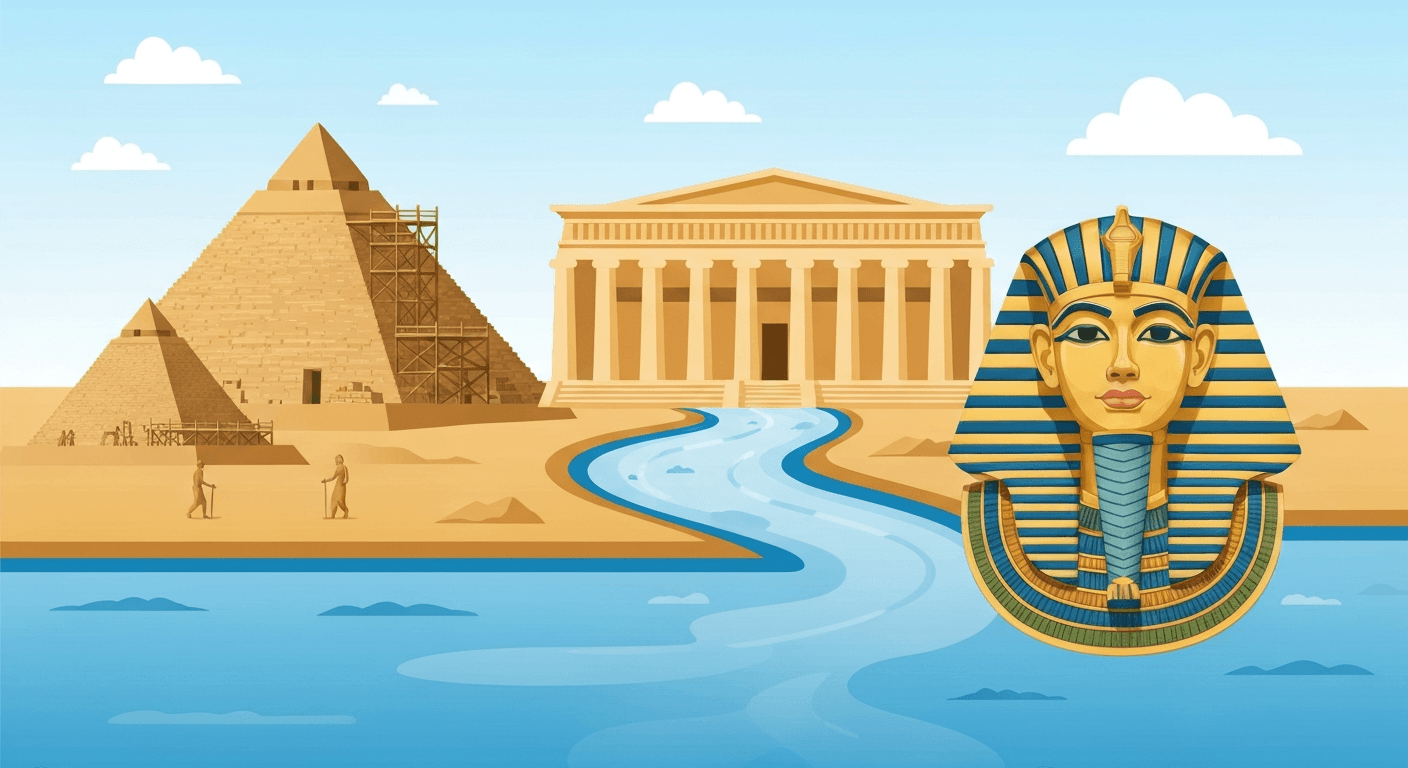
As an educator and content creator here at BrainBeats, I've seen one historical topic confuse students more than any other: ancient Egypt. I remember my nephew, deep into a school project, asking me if Cleopatra helped build the pyramids. It's an easy mistake to make!
Why Egypt Is So Confusing
Because we often teach ancient Egypt as one single, static thing--a monolith of sand, pharaohs, and hieroglyphs. The truth is, the civilization of ancient Egypt lasted for over 3,000 years. That is an almost incomprehensibly long time. More time passed between the construction of the Great Pyramid and the reign of Cleopatra than has passed between Cleopatra and us today.
When facts are presented as a jumbled list of trivia, they don't stick. The student brain, as shown in studies on cognitive load by researchers like John Sweller in the 1980s, needs structure to build lasting knowledge.
A Better Approach: Time Anchors
So, I threw out the trivia list approach. Instead, I'm going to give you a simple framework, a mental timeline with three "time anchors," to hang all those amazing ancient Egypt facts on. This isn't just a list; it's the ultimate Egypt study guide.
How do you make sense of 3,000 years of Egyptian history?
First, let's get the big picture. Historians divide ancient Egyptian history into three main periods of strength and unity:
- The Old Kingdom
- The Middle Kingdom
- The New Kingdom
The problem is, these names are a bit generic and hard to remember. That's where our time anchors come in. We're going to peg our journey to three of the most famous pharaohs, each representing a distinct era and a different phase of Egyptian culture.
- Khufu (c. 2589 to 2566 BCE): The Pyramid Builder of the Old Kingdom.
- Hatshepsut (c. 1478 to 1458 BCE): The Female King of the New Kingdom's golden age.
- Tutankhamun (c. 1332 to 1323 BCE): The Boy King with the famous tomb, also in the New Kingdom.
By remembering just these three rulers, you can start to organize the history in your head. Research in educational psychology, such as the schema theory, shows that our brains learn best when we can connect new information to an existing mental structure. Let's build that structure together.
Who built the Great Pyramid and why?
Setting the Scene
Let's travel back four and a half thousand years to the Old Kingdom. When you think of Egypt, the first thing that probably pops into your head is a massive pyramid. You're thinking of the Old Kingdom, and specifically, the Great Pyramid of Giza. This is our first anchor point.
Pharaoh Khufu commissioned this architectural marvel as his tomb. Here are some core pyramids facts from his era:
- Incredible Scale: The Great Pyramid was built from an estimated 2.3 million stone blocks, some weighing as much as 80 tons. For over 3,800 years, it was the tallest man-made structure in the world.
- A Stairway to the Gods: Its purpose wasn't just to be a big tomb. The Egyptians believed the pharaoh would ascend to the heavens and join the gods in the afterlife. The pyramid was a physical launchpad for that journey.
- Built by Egyptians, for Egyptians: Forget what you've seen in old movies. Archaeological evidence from the Giza Plateau, detailed extensively by experts like Dr. Mark Lehner, shows the pyramids were built by a dedicated, skilled workforce of Egyptians. They lived in a nearby purpose-built city, received payment in the form of food and beer, and were given honored burials. You can read more about their findings on the Smithsonian Magazine's website.
What Khufu's Era Tells Us
Khufu's era represents a powerful, centralized state with the religious conviction and organizational genius to accomplish one of humanity's greatest building projects. Remember Khufu, and you'll remember the great pyramids of the Old Kingdom.
Who was Hatshepsut and why was she important?
Now, let's jump forward more than 1,000 years. We are now in the New Kingdom, and Egypt is a wealthy, sprawling empire. Our second time anchor is one of the most remarkable pharaohs for students to learn about: Hatshepsut.
A Female Pharaoh
Hatshepsut was a woman who, through brilliant political maneuvering, became a full pharaoh and ruled for over two decades. To solidify her power, she adopted all the kingly titles and was often depicted with male muscles and the traditional false beard of a pharaoh.
A New Kind of Legacy
Her reign wasn't about building pyramids; it was about re-establishing trade routes and constructing breathtaking temples. This is a key difference: while Old Kingdom pharaohs focused on their personal tombs, New Kingdom rulers built grand monuments to the gods and were buried in hidden tombs in the Valley of the Kings.
Hatshepsut's mortuary temple, Djeser-Djeseru, is a masterpiece of architecture built into a cliff face. Her story demonstrates a shift in Egyptian culture, wealth, and international power.
Why is King Tut the most famous pharaoh?
The Most Famous Pharaoh
Our final anchor, King Tutankhamun, lived about 140 years after Hatshepsut, still during the New Kingdom. He is arguably the most famous pharaoh, but not for what he did in life. He took the throne as a child and died before he was 20.
His fame comes from one simple fact: his tomb was discovered, almost completely untouched, in 1922 by archaeologist Howard Carter.
The discovery of Tutankhamun's tomb was an electrifying moment for the world. It gave us an unprecedented, detailed look at the wealth and complex beliefs surrounding a pharaoh's journey to the afterlife. For a deep dive, the BBC History page on Tutankhamun is a fantastic resource.
What the Tomb Reveals
King Tut's tomb provides the perfect lens to understand New Kingdom burial practices:
- Hidden Tombs: His tomb was a relatively small, hidden chamber in the Valley of the Kings, a stark contrast to the massive, visible pyramids of Khufu's time.
- Incredible Wealth: It was packed with over 5,000 artifacts, including his iconic solid gold death mask, chariots, furniture, and jewelry, all meant to serve him in the next life.
- Elaborate Beliefs: The nested coffins, the spells from the Book of the Dead painted on the walls, and the intricate mummification process all point to a highly evolved set of beliefs about preserving the body for the soul's return.
By remembering Tutankhamun, you anchor yourself in the late New Kingdom, the era of hidden tombs and unimaginable golden treasures.
Why was the Nile River so important to ancient Egypt?
The Gift of the Nile
While pharaohs rose and fell and building styles changed, one thing remained constant: the Nile River. The Nile River history is Egypt's history. The Greek historian Herodotus famously called Egypt "the gift of the Nile," and he was absolutely right.
Its predictable annual flood, known as the inundation, deposited a layer of rich, black silt that made the land incredibly fertile. This natural cycle was the bedrock of their entire civilization.
The Nile's Many Roles
It served many vital roles:
- It dictated their calendar.
- It fueled their agricultural wealth.
- It served as their main highway for transporting goods, armies, and the giant stones needed for their monuments.
Whether it was Khufu building his pyramid or Hatshepsut sending a trade expedition, the Nile made it all possible. It was the lifeblood that pulsed through all 3,000 years of this incredible civilization. It's a theme we explore in many of our songs in our Ancient Egypt collection.
How can I remember all these ancient Egypt facts?
So, the next time you think about ancient Egypt, don't just picture a jumble of facts. Use our time anchors:
- Picture Khufu and his giant pyramid.
- Then jump a thousand years to Hatshepsut and her grand temples.
- Finally, land with Tutankhamun and his hidden, golden tomb.
By framing the timeline this way, you give your brain the structure it needs to make sense of this long and fascinating history.
History is a story, not just a list of dates. Once you have the main characters in place, you can explore all the other amazing details with confidence. If you want to see how this period connects to other great civilizations, check out our full collection of Ancient History songs!
Frequently Asked Questions
How long did ancient Egypt last?
Were the pyramid builders slaves?
Why did Egyptian pharaohs wear fake beards?
What are hieroglyphs?
Is the 'curse of the pharaohs' real?
Ready to learn through music?
Explore BrainBeats and start turning facts into songs you will actually remember.
More in History
Can you learn world history through songs?
Tired of memorizing disconnected dates? We believe learning history through music is about understanding the 'why,' not just the 'what.' This post explores how songs can illuminate the cause-and-effect chains that truly shape our world.
February 14, 2026What is the difference between ancient Greece and Rome?
Ever mix up Zeus and Jupiter, or the Parthenon and the Pantheon? This Greek Roman history guide is designed to clear up the confusion once and for all.