Does music actually help you study better?

Founder of BrainBeats. Writing about learning science, memory, and the intersection of music and education.
I can still, without a moment's hesitation, sing you the entire jingle for a local car dealership that went out of business in 1998. I can't tell you what I had for lunch last Tuesday, but the phone number for that dealership is seared into my brain, set to a jaunty pop tune. It's a perfect, useless piece of long-term memory.
We've all experienced this phenomenon. A snippet of a pop song, a theme from a cartoon, or a grammar rule set to music in elementary school sticks with us for decades. Yet, the crucial details from a textbook chapter we crammed for an exam vanish within days. This isn't a coincidence; it's a clue to how our brains are wired to learn.
The Conventional Wisdom Is Incomplete
Most articles that pop up when you search for "how music helps you study" focus on using music as a background tool--a kind of auditory wallpaper to improve focus or mood. They suggest lo-fi beats or classical concertos to get you in the zone. While there can be some merit to that, I believe it misses the point entirely.
The true cognitive power of music isn't unlocked when it's in the background. It's unlocked when the music is the lesson.
Why doesn't background music help you study?
The Mozart Effect Myth
Let's address the elephant in the room: the so-called "Mozart Effect." This idea, born from a 1993 study by Rauscher, Shaw, and Ky, suggested that listening to Mozart could temporarily boost spatial reasoning skills. The media ran with it, and soon, parents were playing classical music for their infants, hoping to raise tiny geniuses.
However, subsequent research showed the effect was minimal, temporary, and not specific to Mozart. The real takeaway was that engaging, complex audio could prime the brain for certain tasks, but it wasn't a magic bullet for learning facts.
The Problem with Background Music
In fact, for complex learning that requires deep reading and comprehension, background music can be a detriment. Your brain has a limited amount of attentional resources, a concept known as cognitive load. If you're trying to understand the causes of the Peloponnesian War, but your brain is also processing a complex symphony, you're splitting your focus.
The music becomes cognitive noise, competing with the information you're trying to absorb. So, we need to shift our thinking. Instead of asking what music to play while we study, we should be asking how we can turn our study material into music. This is where the real study music science begins.
What is dual coding and how does it help memory?
Two Channels, One Brain
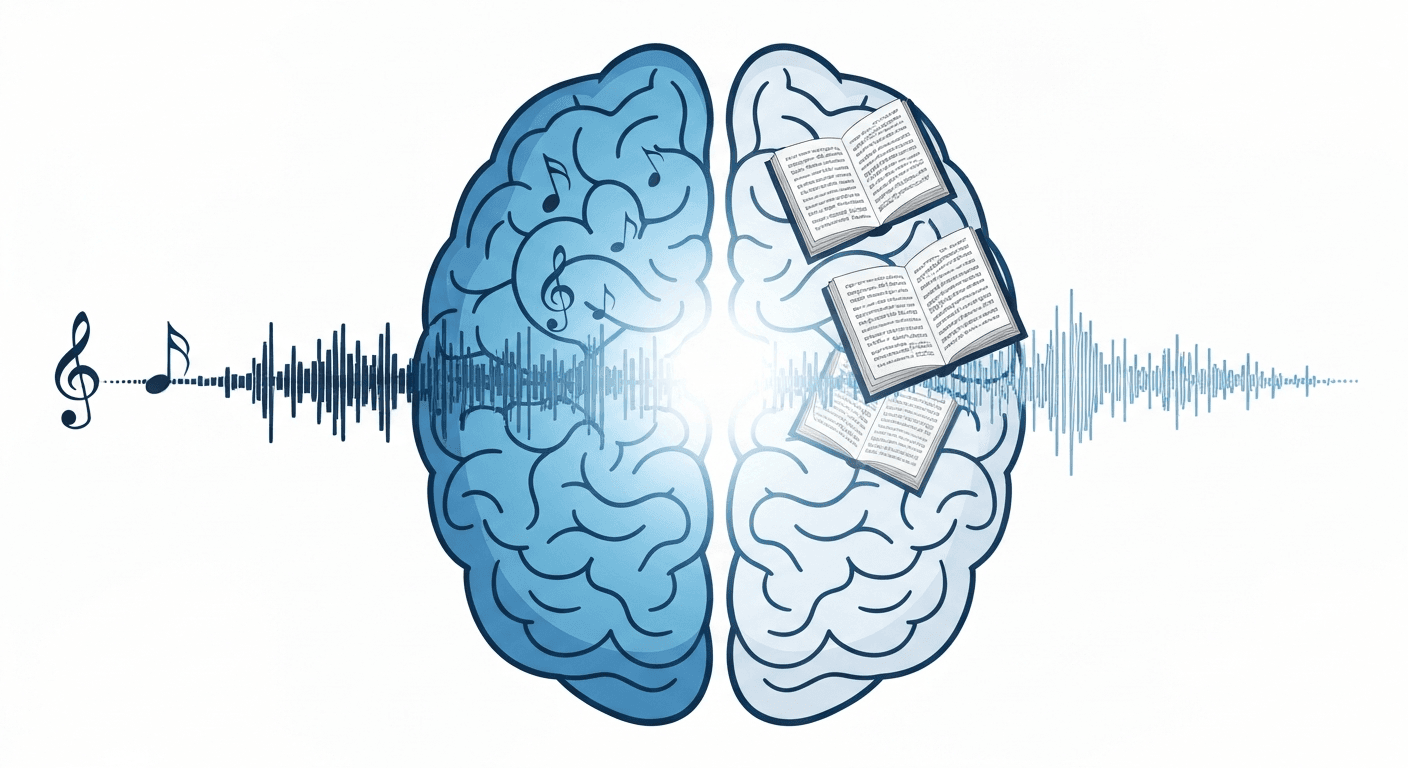
One of the most powerful explanations for why learning with music works so well is Allan Paivio's Dual Coding Theory, first proposed in 1971. The theory is elegantly simple: our brains process and store information through two distinct channels:
- A verbal channel for language (words, text)
- A non-verbal channel for imagery and other sensory information (like pictures, sounds, and melodies)
When you read a textbook, you are primarily using your verbal channel. You're reading words, and your brain is decoding them as linguistic information. It's a single-lane highway into your memory.
How Music Engages Both Channels
But when you listen to a song about, say, the gods and goddesses of Ancient Greece, you engage both channels simultaneously. You get:
- Verbal Information: The lyrics themselves--the names of the gods (Zeus, Hera, Apollo), their domains, and their stories.
- Non-Verbal Information: The melody, rhythm, harmony, and emotional tone of the song. A booming, powerful melody for Zeus creates a different mental association than a light, airy tune for Aphrodite.
Two Retrieval Paths Are Better Than One
By encoding the information in two ways, you create two distinct retrieval paths in your brain. On test day, if you can't recall the words directly, you might be able to recall the tune, which then triggers the lyrics.
As cognitive scientist Dr. Daniel Levitin discusses in his work, music is deeply tied to the brain's emotional and memory centers. This dual-coding approach makes the memory more robust, resilient, and far easier to access later. It's the difference between having one key to a door and having two.
Why does singing help you remember things?
The Science of Reading Aloud
Have you ever noticed that you remember something better if you say it out loud? That's not just a feeling; it's a well-documented cognitive phenomenon called the "production effect." A landmark 2010 study by MacLeod and colleagues, published in the Journal of Experimental Psychology, found that people have significantly better memory for words they read aloud compared to words they read silently.
Producing the information--actively doing something with it--forces a deeper level of processing. It's the difference between being a passive observer and an active participant.
Singing: The Production Effect on Steroids
Now, let's apply this to music and memory. Singing along to a song is the production effect on steroids. You are not just vocalizing words; you are:
- Coordinating your vocal cords to match a specific pitch.
- Timing your words to fit a specific rhythm.
- Engaging motor-planning areas of your brain.
- Often, tapping your foot or nodding your head, adding a kinesthetic layer.
Why You Remember Lyrics for Decades
This multi-modal act of production creates an incredibly rich, sticky memory trace. It's why you can remember the lyrics to hundreds of songs you haven't heard in years. You didn't just hear them; you *produced* them.
When you sing our song about the Roman Emperors from our Ancient Rome collection, you are actively rehearsing and reinforcing that information in a way that passively reading a list can never match.
How can I use music to study more effectively?
So, how can you apply this knowledge? It's time to rethink your study habits.
- Seek out content-rich music: Instead of searching for "study beats," search for songs about the Krebs cycle, the amendments to the Constitution, or the timeline of Ancient Egypt. At BrainBeats, this is exactly what we do. We turn curriculum-aligned facts into unforgettable songs.
- Be an active listener: Don't just put the song on. Close your eyes and listen. Pay attention to how the melody connects to the words. What emotional tone does the music create for the topic?
- Sing it loud, sing it proud: Maximize the production effect. Sing along in the car, in the shower, or while walking the dog. The more you produce the information through song, the more deeply you will encode it. Don't worry about being a great singer; the cognitive benefit comes from the act of production itself, not the quality of the performance. For a great resource on the cognitive benefits of singing, check out this article from the BBC on the psychology of singing.
We founded BrainBeats on this very principle: that the most effective learning is active, engaging, and joyful. It's not about finding tricks to endure studying; it's about transforming the material itself into something your brain is naturally designed to remember. You can learn more about our philosophy on our about us page.
Should I study with music or study the music itself?
The next time you're facing a tough study session, I challenge you to close that generic 'focus' playlist. The idea that music helps you study isn't wrong, but the conventional wisdom has been pointing us in the wrong direction. The secret isn't finding the perfect ambient sound to ignore; it's finding an amazing song you can't ignore.
By leveraging the power of Dual Coding Theory and the production effect, you can create memories that are stronger, last longer, and are easier to recall under pressure. You can make learning as effortless and sticky as that annoying jingle from your childhood. You just have to change your tune and let the lesson be the song itself.
Frequently Asked Questions
What's the best type of music to study with?
Does learning with music work for all subjects?
I'm not musical at all. Will this method still work for me?
Is there a real difference between just listening to a song and reading the lyrics?
Where can I find good educational songs for my studies?
Ready to learn through music?
Explore BrainBeats and start turning facts into songs you will actually remember.